For years, judging a publisher came down to a handful of numbers: authority, traffic, the share of that traffic from the right country. Those numbers still matter. They no longer tell the whole story, because a growing share of search ends in an answer and not in a list of links.
An answer has sources. Whether a publisher is one of them is a different question from how strong its domain is, and the two do not always agree.
What the data is
AI citation data shows whether ChatGPT and Google AI Overviews actually use a domain as a source. It is recorded per publisher and per market, and it sits next to the classic metrics of that publisher. It is refreshed when the publisher data is synced, so you look at the current state and not at a snapshot from the day the domain was added.
What it adds to the classic metrics
Read on their own, classic metrics treat every strong domain as equally useful. Citation data separates them:
- Strong domain, cited often. The domain carries authority and is also read by the systems that write the answers. This is where a placement works twice.
- Strong domain, cited rarely. Still a sound link in the classic sense. It does less for visibility in AI answers.
- Modest domain, cited often. Easy to overlook on metrics alone. In a niche, these can be the specialist sites that answers lean on.
The direction matters as much as the level. A domain that is cited less and less is a different purchase from one that is on the way up, even when both look the same today.
What it does not tell you
Citation data says something about the publisher, not about your article on it. A placement on a domain that is cited often is not a promise that your page will be cited. It also does not replace the judgement on topical fit: a domain can be a trusted source in one subject and irrelevant to your client.
We use it for the question it can answer: given two publishers that both pass the quality gates, which one is more likely to count where search is going.
Read it before you spend
The moment to look at citation data is before the order, not in the report afterwards. That is why it belongs with the publisher and not in a separate tool: the person who proposes a placement sees it at the same time as the other metrics, without looking anything up.
Where it sits in ECHION
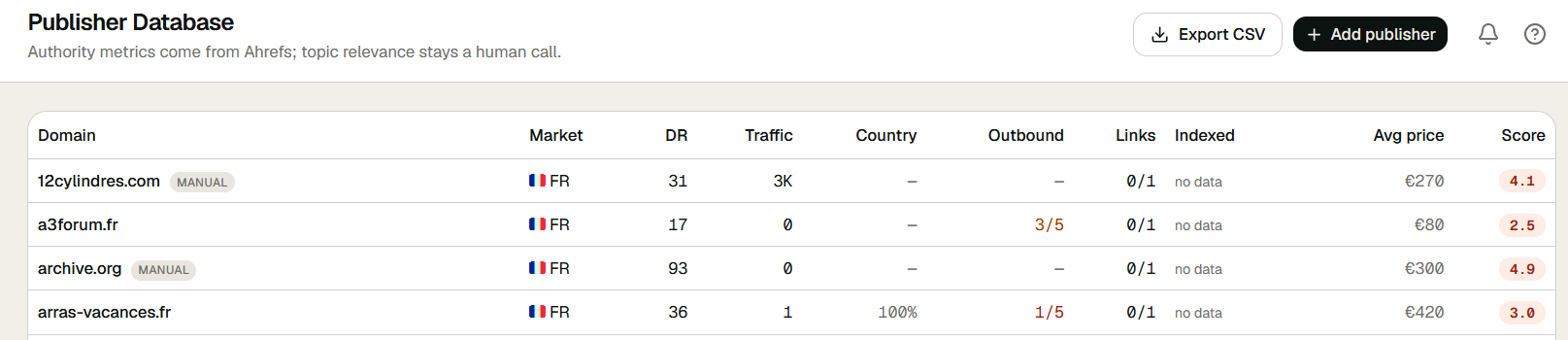
Every publisher in the Publisher Database carries its AI citation data next to its classic metrics. The screenshot below shows the classic side of the database: one row per domain, with its market and its metrics.
How we judge the rest of a publisher is described in judging a publisher once, for every client. The GEO layer is described on the platform page.
More in the knowledge base, or see how the platform puts this into practice.