A link that should not have been bought is rarely a surprise afterwards. The domain was already in use for another client, the anchor pushed the profile too far towards exact match, or the sprint budget was already spent. Each of those facts was known somewhere before the order went out. It was just not in front of the person who made the decision.
That is the problem quality gates solve. This article describes how we set them up and what they do and do not replace.
Guidelines get skipped, gates do not
Most teams that build links have a guideline: minimum metrics, anchor rules, a list of domains to avoid. A guideline depends on everyone reading it, remembering it and applying it the same way on a busy day. With several partners building for several clients at the same time, that does not hold.
A gate is a rule a placement has to pass before it can move on. Nobody has to remember it, and nobody can skip it because a deadline is close. The rule is applied the same way to the first placement of the month and the last.
What the gates check
The checks fall into four groups:
- Publisher metrics. The domain has to meet the quality thresholds that apply to that market.
- Anchor rules. The proposed anchor has to fit the anchor plan of the client. More on that in anchor planning across multiple clients.
- Duplicate domains. The domain is checked against the placements of all your clients, not only the one it is proposed for.
- Budget caps. A placement cannot take a sprint over its budget.
Thresholds are set per market, with overrides per partner or client where that is needed. A market where good publishers are scarce does not have to follow the same numbers as a market where they are not.
The partner sees what fails and why
A rejection without a reason costs two rounds of messages: one to ask what was wrong, one to answer. So the partner who proposes a placement sees exactly which rule fails and why. Most problems are then fixed before the placement reaches the manager at all. What arrives in the approval queue has already passed the measurable part.
Approval stays a human step
Gates check what can be measured. Whether a site makes sense for this client, in this market, next to the links that are already there, is a judgement. That is why a placement that passes every gate still waits for a manager to approve it. We treat that step as part of the quality, not as a delay: no placement goes out without someone having looked at it.
How it looks in ECHION
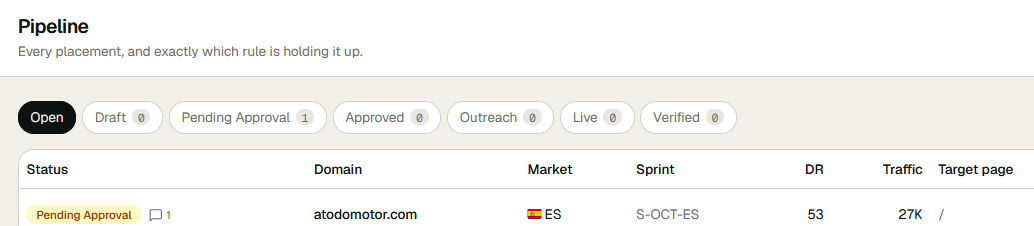
In the Pipeline, every placement has a status: Draft, Pending Approval, Approved, Outreach, Live and Verified. Each row shows the domain, the market, the sprint, the target page, the anchor and a quality score, and the discussion about a placement sits on the placement itself. When a placement is held up, the Pipeline shows which rule is holding it. Rejected and cancelled placements move to the Archive, where they stay on record.
The gates are the same whether we run the link building for you with Outsourced or your own team runs it with Self-serve.
More in the knowledge base, or see how the platform puts this into practice.