When a placement is rejected, the natural thing to do is remove it. It is not going to happen, so it clutters the list. A few months later the same domain is proposed again, by someone else, for the same client, and nobody remembers why it was turned down.
We keep rejected and cancelled placements, and the reason with them. Here is why.
A rejection is a decision worth keeping
Every rejection contains a judgement someone took the time to make: this domain does not fit this client, this anchor is wrong for this page, this publisher changed its terms. Deleting the placement throws that judgement away.
Kept on record, it does three things:
- It prevents the same proposal twice. The reason is there the next time the domain comes up.
- It shows patterns. Many rejections for the same reason point at the brief or at the choice of publishers, which is also what the acceptance figure in the partner scorecard picks up.
- It answers questions later. Why a link was not built is asked as often as why one was.
Out of the figures, not out of sight
Keeping a placement is different from counting it. A rejected or cancelled placement should not use up budget, should not count towards the link target of a sprint and should not shift the anchor mix. If it did, the figures of a running sprint would be wrong.
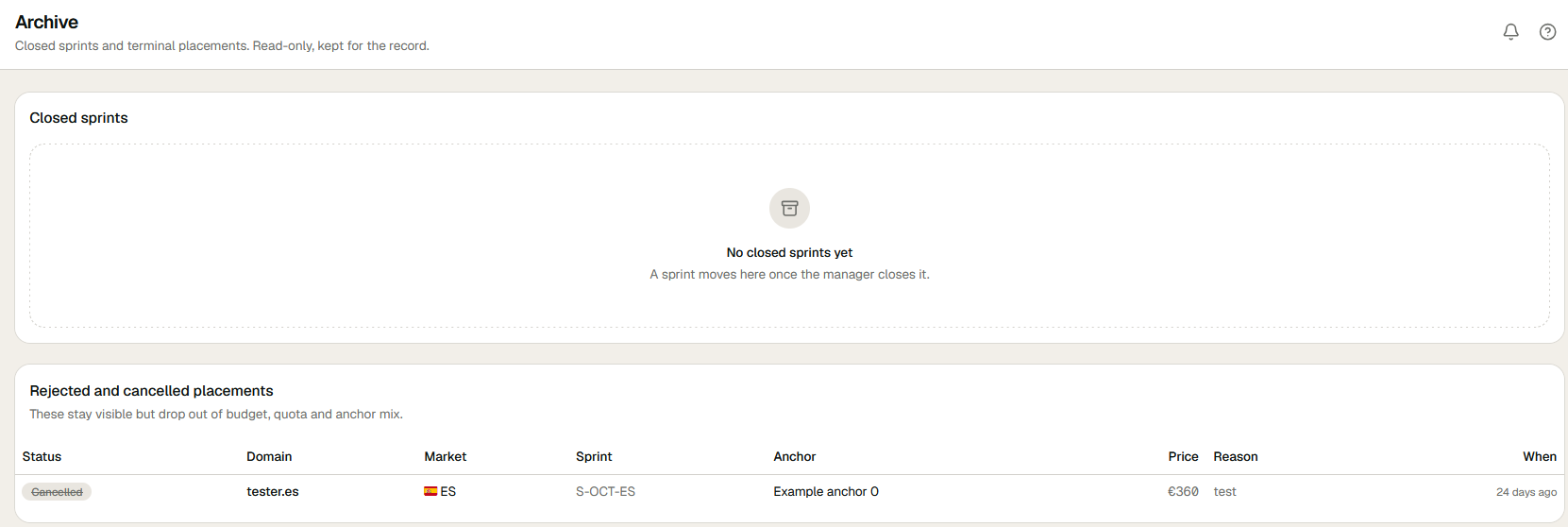
So these placements stay visible and drop out of budget, quota and anchor mix. The working view stays clean, because open placements and closed ones are not in the same list.
Closed sprints are read-only
The same goes for a sprint that is finished. When the manager closes a sprint, it moves to the archive and can no longer be changed. What was planned, what was spent and what was delivered stays as it was on the day it closed.
That matters more than it seems. A report to a client is only worth something when the figures behind it cannot quietly change afterwards.
The audit trail
Behind every placement is a series of decisions: who proposed it, which gates it passed, who approved or rejected it and why. Keeping that trail with the placement means the answer to a question about a link from last year is already there. Nobody has to search a mailbox or ask a colleague who has since moved to another client.
How it looks in ECHION
The Archive has two parts. Closed sprints are listed read-only. Rejected and cancelled placements are listed with their status, domain, market, sprint, anchor and the reason.
The Archive is the last of the modules on the platform. What happens to a placement before it gets there is described in quality gates.
More in the knowledge base, or see how the platform puts this into practice.